

Custom Outdoor Bar Options: How to Choose the Right Fit
You want a custom outdoor bar for game days and weekend hangs, but the path to get one isn't obvious. Do you hire a contractor and wait months on their schedule? Order a flat-pack kit and spend your weekends assembling it yourself? Or is there a faster third option? This breakdown weighs all three so you can pick the one that actually fits your yard, your budget, and your patience.
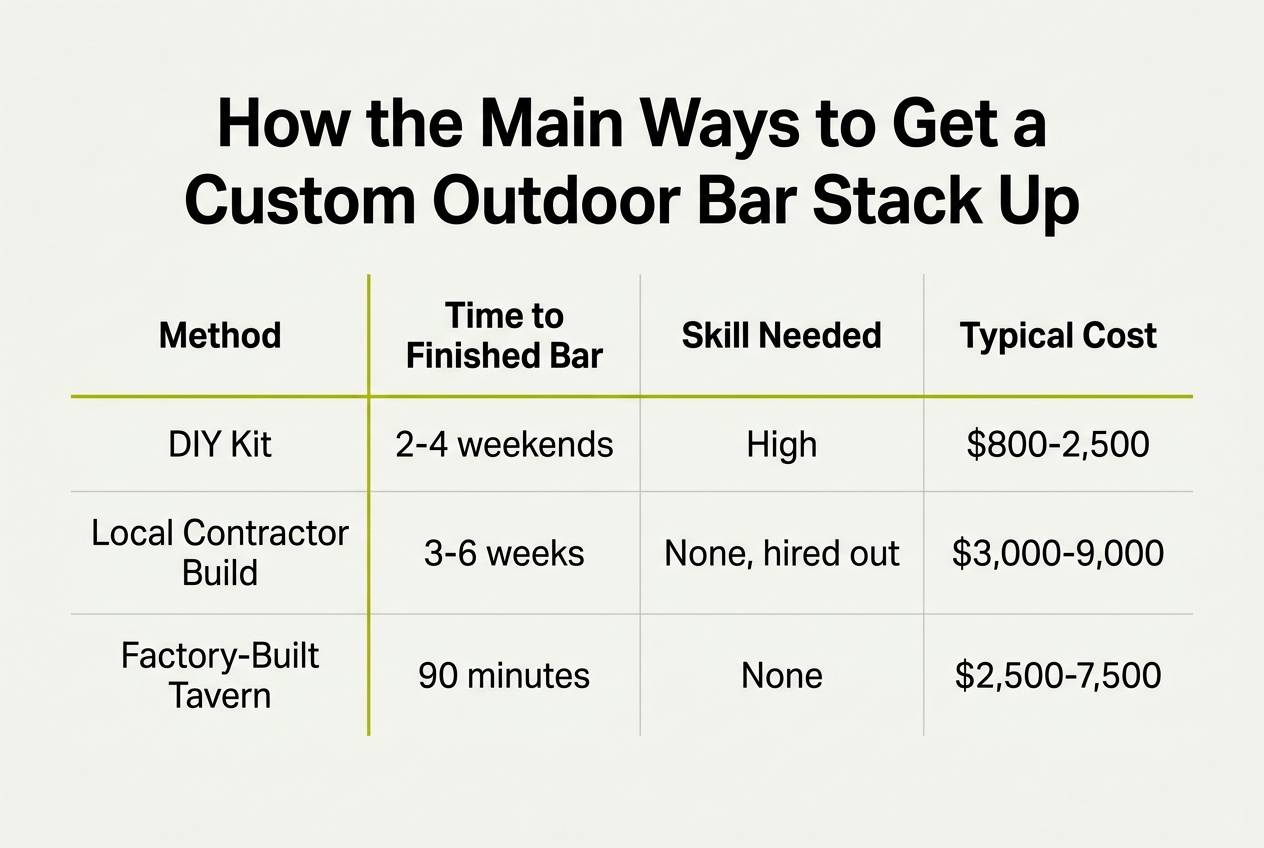
How the Main Ways to Get a Custom Outdoor Bar Stack Up
The three build paths, defined
Three routes get you a backyard bar. You buy plans or a flat-pack kit and build it yourself, weekend by weekend. You hire a local contractor to frame and finish one on-site, timeline dependent on their schedule. Or you order a factory-built prefab, delivered and put together right in your yard. Each path handles cost, time, and skill differently. And that's before you factor in your own patience for power tools.
Understanding realistic outdoor bar cost ranges up front helps you judge which path actually fits your budget. Materials, labor, and delivery fees stack up differently across all three.
Scoring criteria used throughout this guide
To keep comparisons fair across this guide, we're scoring each route on four things: build time, cost predictability, customization, and durability. Here's how the three paths generally shake out.
| Build path | Typical build time | Cost predictability | Durability consistency |
|---|---|---|---|
| DIY kit or plans | 2-4 weekends | Low — tool and material surprises add up | Varies by builder skill |
| Local contractor build | 2-6 weeks, weather dependent | Moderate — quotes shift with change orders | High, but crew-dependent |
| Factory-built prefab, delivered | About 90 minutes on-site | High — fixed price before delivery | Consistent, factory-standard build |
That last row is the outlier worth noting. Prefab delivery removes the build step completely. There's no framing, no weekend lost to a miter saw, no waiting on a contractor's calendar. A crew shows up, assembles the structure, and drives off — about 90 minutes start to finish. For anyone who's sat through a stalled deck project, that number alone changes the math.
DIY Bar Kits vs. Factory-Built Taverns
Time and skill investment compared
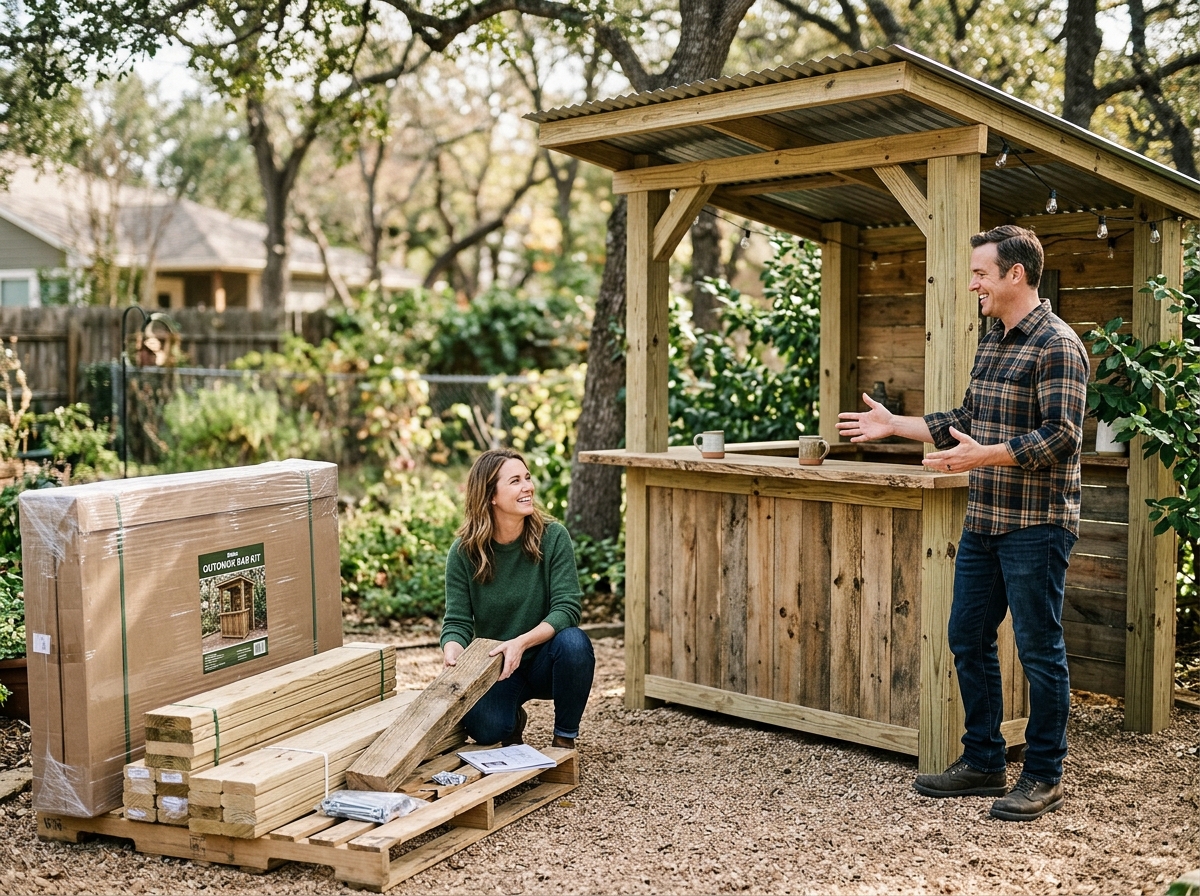
Building from a plan set sounds simple until you're standing in a lumber yard trying to figure out how many 2x4s a roof truss actually needs. Most DIY backyard bar plans ask you to source your own materials, measure, cut, and frame everything yourself. That usually eats an entire weekend if you're experienced, and much longer if you're not. Tools matter too. A circular saw, a level, a drill, clamps, and some patience are the bare minimum. If you're reading diy outdoor bar guides for the first time, expect a learning curve on top of the labor.
Factory-built Taverns skip that whole process. A Temple Bar or Castlebar arrives pre-engineered, with panels cut to spec at the workshop, and a crew puts it together on-site in about 90 minutes. The Dunbar and 7-Up, along with their Deluxe versions built on 6x6 posts, follow the same model just at a larger scale. No tools, no trips to the lumber yard, no wasted Saturday. That trade-off — a weekend of sweat versus 90 minutes of watching — is really the whole decision in a nutshell.
Long-term durability differences
Here's where DIY plans tend to fall short. Improvised measurements and mismatched lumber grades lead to common problems down the road: rot-prone wood that wasn't rated for outdoor exposure, roof framing that sags under wind or snow load, and joints that loosen because they weren't engineered for the stress. It's not that DIY builders are careless. It's that a backyard project rarely gets tested against a structural spec the way a factory design does.
Factory builds address this from the start with grade #1 pressure treated lumber and galvanized corrugated steel roofing. Materials chosen specifically for years of outdoor weather, not a single season. The Deluxe Collection pushes that further with 6x6 posts and 6-inch roof framing, giving the structure meaningfully more rigidity than a standard DIY frame. Financing options also come standard with most factory builds, spreading the cost over time — something plan sellers almost never offer, since they're just selling you paper and a parts list. Not a finished structure, and not the backing to pay for one.
Hiring a Local Contractor vs. Ordering a Custom Outdoor Bar Prefab
Timeline and cost predictability
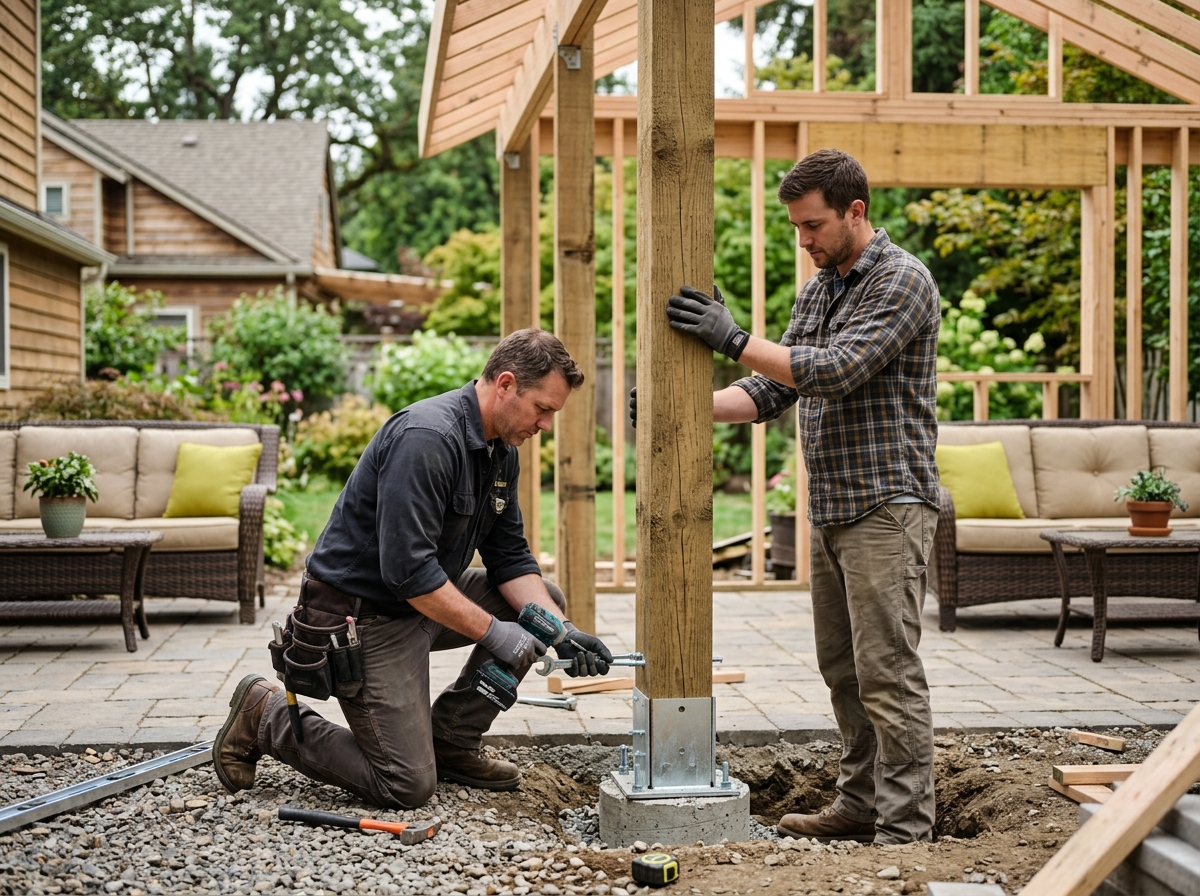
A general contractor has to fit your bar between other jobs. That means quotes with wide ranges and timelines measured in weeks, not days, especially once permitting and inspection scheduling get involved. Weather delays, subcontractor no-shows, material backorders — it all pushes the finish date. Nationwide prefab delivery, by contrast, runs out of set workshop locations in Paterson NJ, Oldsmar FL, and South San Francisco CA, covering nearly all of the Continental US on a predictable schedule. If you're weighing whether a flat-pack approach is worth it before committing to either path, it's worth learning more about what a cheap diy outdoor bar actually costs once tools and time get factored in.
Design flexibility and track record
Contractors win on one-off, wildly custom features — a built-in fireplace niche, oddball angles, that sort of thing. But most homeowners don't need that. A Signature Collection spanning five distinct styles covers the bulk of taste and layout preferences without paying for custom drafting. Reviews are the real gap, though. Contractor quality swings project to project, and you're often relying on word of mouth or a handful of scattered listings. Here's the blunt version: a contractor's last five-star job says nothing about yours.
| Factor | Local Contractor | Prefab Delivery |
|---|---|---|
| Typical timeline | Several weeks, permit-dependent | Delivery scheduled, ~90-minute assembly |
| Payment structure | Deposit plus staged payments | Full refund guarantee if unfulfilled |
| Coverage area | Local service radius only | Nearly all Continental US states |
| Design range | Broad, fully custom features | Five Signature styles plus Original/Deluxe tiers |
| Review consistency | Varies job to job | 5.0 rating, 60+ reviews, 5,000+ delivered |
Staged payments with a contractor make sense for long jobs. You're paying as milestones get hit, which protects both sides. Just know that deposits are rarely refundable if plans change midstream. A refund guarantee tied to a specific delivery commitment is a different kind of protection: less flexible mid-project, but far less risky upfront.
Original Collection vs. Deluxe Collection: Choosing Your Structure
Picking a size isn't about how much you want to spend. It's about who's actually showing up. A four-top for Sunday coffee and a twelve-person football crowd need very different footprints. Guessing wrong means either a cramped bar or wasted yard space.
Matching size to guest count
The Original Collection runs standard framing from small to x-large, and each size lines up with a rough guest range. Here's how the four sizes generally break down for entertaining:
| Size (Original) | Best for | Typical guest count | Yard footprint needed |
|---|---|---|---|
| Temple Bar (small) | Couples, small patios | 2–4 people | Compact corner spot |
| Castlebar (medium) | Weekend entertaining | 4–8 people | Moderate side yard |
| Dunbar (large) | Game-day hosting | 8–12 people | Larger open area |
| 7-Up (x-large) | Big gatherings, poolside hubs | 12+ people | Full-width yard space |
Measure your actual usable space first. A 7-Up looks great in a photo but overwhelms a small patio fast.
When the Deluxe upgrade is worth it
Every Deluxe model swaps in 6x6 posts and 6-inch roof framing, giving you a heavier, deck-grade structure. That matters most in exposed or windy backyards, where a lighter frame takes a beating over a few seasons. It also matters if you just prefer things to feel solid underfoot and overhead. Both collections, Original and Deluxe alike, support a customizable entry side and adjustable height or roof configuration. So low headroom or a mounted 65-inch TV isn't a dealbreaker either way. The honest verdict: if your yard catches wind off an open field or a lake, pay for Deluxe. If it's tucked behind a fence line with decent shelter, the Original Collection holds up fine and saves you money for accessories.
What a Custom Outdoor Bar Solves vs. What It Doesn't
Entertaining and hosting needs it covers
A well-built backyard bar earns its keep on the nights that actually matter — game days, a Saturday cookout, the random Tuesday your neighbors wander over. It gives people a reason to gather somewhere other than the kitchen island. That's the real problem being solved here: not lumber, not roofing, but the lack of a spot that pulls a crowd.
Where the coverage stops matters just as much as where it starts. Here's what's genuinely included versus what you're still lining up on your own:
- Grilling solutions and shed/bar combos act as the closest thing to a full entertaining hub, but they're not a plumbed outdoor kitchen — cooking hardware and any water lines still get arranged separately.
- Bartender accessories and essentials handle the serving side of things: bottle openers, shelving, that kind of gear, but there's no sink or drain built in.
- Winterize panels stretch your season into fall and early spring, which helps, but they don't turn a Tavern into a heated, code-compliant room.
- Painting packages let you match the bar to your patio or deck color scheme without hiring a separate painter.
- Adjustable roof and height configurations mean a mounted TV or low-clearance patio isn't a dealbreaker before you even order.
Utilities and sitework it leaves to specialists
This is the part people skip past and then get surprised by later. No electrical wiring is included — if you want a TV, string lights, or an outlet for a blender, that's a local electrician's job. The structure is built to accommodate it, but nobody's running romex for you.
Same story with water. There's no plumbing, no sink, no drain line. It's a dry bar unless you bring in a plumber separately. And a kegerator? You can absolutely house one — plenty of owners do — but that's a customer-supplied unit dropped into the structure, not a draft system installed with glycol lines and taps. Sizing questions go to phone or text support, seven days a week.
Foundation work is the other big one. There's no poured slab here. The site needs to be reasonably level before free delivery and assembly happens, so grading, pavers, or hardscaping prep is on you or your landscaper. Skip that step and even a 90-minute assembly turns into a headache.
Standalone Bar vs. Pairing With Existing Backyard Features
Most backyards already have something going on. A pool, a deck, maybe a hot tub tucked in the corner. You don't need to redesign your whole yard around a new bar — you need it to slot into what's already there. That's really the design question here: does it stand alone, or does it work with what you've got?
Pairing with pools, decks, and hot tubs
A poolside bar is one of the most natural pairings there is. A Dunbar or 7-Up sized structure placed a few feet from the water becomes the drink station for the whole afternoon, and winterize panels close it up when pool season ends. Decks work a little differently. If a deck or patio already exists, a Deluxe Collection Tavern with 6x6 posts adds a deck-grade structure right beside it — no need to bring in a separate deck contractor for reinforcement. Hot tubs follow the same logic: install a Tavern nearby and it becomes the hot-tub-side bar, delivered and assembled free in about 90 minutes.
- Poolside placement turns a Dunbar or 7-Up into the go-to drink station without crowding the pool deck itself
- Deluxe Collection 6x6 posts give deck-adjacent Taverns the sturdier framing decks demand, minus the extra contractor
- Hot tub pairing works best a few feet back, keeping steam and splash away from the bar's roofline
- Winterize panels stretch usable months for both poolside and hot-tub setups once temperatures drop
- Fire pits are a different story — open flame near pressure-treated wood needs real clearance, so keep any fire feature a safe distance away and let a specialist advise on that setup
Coordinating with fences and landscaping already in place
Finish tones matter more than people expect. A Tavern built from grade #1 pressure treated lumber will generally match the tone of a quality wood fence already standing in the yard, so the two don't clash. That said, the surrounding footprint — fence lines, planting beds, mulch, grading — isn't something a bar provider touches. A fence contractor or landscaper still owns that piece. Think of the Tavern as the anchor point everything else gets arranged around, not the thing doing the arranging.
New Build vs. Repair: When to Order Fresh Instead of Restoring
Signs it's time to replace rather than repair
Take a hard look at that old tiki bar or wet bar before you spend another weekend on it. Soft, spongy wood along the base, a roof that's rusted through, or paint so faded you can't tell the original color — these are repair and refinishing problems, and they sit outside what a new-build company handles. Sourcing that kind of specialist takes time, and results vary a lot depending on how far the rot has spread.
Here's the blunt version: once structural rot sets in, you're not saving money by patching it. You're just delaying the rebuild. A dedicated provider that builds new backyard bars isn't set up to restain or rebuild someone else's aging structure — the scope is fresh construction and installation, not on-site restoration work.
That's actually good news for cost planning. A new Original or Deluxe structure, delivered and assembled in about 90 minutes, often beats the total time and expense of hunting down a refinishing crew, waiting on materials, and hoping the frame underneath is still sound. If the bones are failing, replacing wins.
Where to direct repair-specific questions
If you're not sure whether your bar is salvageable, ask before you buy anything. Phone or text support at (929) 405-9918, open 8am to 6pm EST seven days a week, can walk you through what's realistic for a new order versus what falls outside scope entirely. It won't fix an existing structure, but it will save you a wasted purchase.
One thing worth knowing: painting packages only apply at time of a new order. You pick your finish upfront, rather than trying to restain a weathered structure years down the line. That's a meaningful difference from a repair job, where refinishing is the whole point.
For most aging backyard bars, going fresh with a new Original or Deluxe Tavern is simply faster than chasing down a refinishing specialist, comparing quotes, and hoping the fix holds through another winter. Sometimes the smartest repair decision is skipping the repair.
Final Verdict: Which Route Fits Your Backyard
Boil it all down and the decision usually comes down to what you value most: time, control, or peace of mind. Here's the quick version.
Quick recommendation by buyer type
DIY kits suit one type of buyer: someone with a real toolbox, a free weekend (or three), and no problem if the roofline ends up slightly off-square. Local contractors make sense for one-off architectural projects where budget and timeline can flex. Factory-built structures win when you want speed and price certainty — think 90-minute assembly, nationwide free delivery, financing, and a track record that includes a Shark Tank deal and Wall Street Journal coverage backed by 5,000+ units delivered.
| Buyer type | Best-fit route | Typical timeline | Cost predictability |
|---|---|---|---|
| Weekend host wanting game day space fast | Factory-built Tavern | About 90 minutes on-site | Fixed, quoted upfront |
| Newlyweds upgrading a first backyard | Factory-built Tavern | Days from order to install | Fixed, financing available |
| Homeowner wanting a fully custom, one-of-a-kind structure | Local contractor | Weeks to months | Variable, permit-dependent |
| Hands-on builder with tools and patience | DIY kit | Multiple weekends | Unpredictable, hidden costs common |
If you're chasing that Shark Tank-inspired tavern look, the factory route gets you there fastest. And here's the blunt part: a contractor deposit is gone the moment you sign, DIY money is gone once you've cut the wood wrong. A full refund guarantee, by contrast, actually protects you.
Ultimately, the choice between a DIY kit and a fully assembled structure comes down to how much of the build process someone actually wants to take on, versus how much time they'd rather spend using the space instead. It's worth asking honestly how many weekends a project might eat up, what happens if a step gets skipped or done wrong, and whether the savings on paper hold up once tools, materials, and trial-and-error are factored in. Those answers look different for every household, but they're worth sitting with before the first board gets cut.